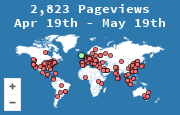
Both tools start from the same event: something on the page was requested. A hit counter stops at the tally. A visitor map keeps a place, a page, and a referrer with the tally, and draws the places where other people can see them. If you only wanted a digit in the footer, the map is extra. If you wanted to see whether anyone outside your city loads the site, the digit is not enough.
The same unit, different leftovers
| Hit counter | Visitor map | |
|---|---|---|
| What increments | A load of the snippet | A load of the snippet |
| What you keep | The total | The total, plus country, page, referrer, user agent |
| What visitors see | A number | A map or a globe, and sometimes the number |
| What it is bad at | Saying where or why | Sessions, uniques, funnels |
| Setup | One snippet | One snippet |
MapMyVisitors is the second column. The image embed can be nearly invisible, which makes it behave like a counter, or it can be a visible map. The stats page is the same either way. Choosing the visible map does not change the unit. What a counter counts still applies: loads, not people.
When the number is the whole job
A footer that says the page has been loaded, on a personal site, for the pleasure of the number. You will not open a country table. You will not explain a referrer. A counter is honest about being small. A map you never look at is a picture you are paying attention for, in the form of layout space, and not using.
When the map earns the space
You publish for readers you cannot see, and "are they anywhere but here?" is a real question. You want that answer on the page, not only in a login. You are willing to treat cities as hints and countries as the figure, which is the geolocation limit. Then the map is the feature and the count is the caption.
Neither tool replaces a suite when the question is a funnel or a campaign. That comparison is Google Analytics alternatives. Between these two simpler tools, pick the map if you will read the places, and the bare counter if the digit is the point. Installing both on the same pages double-counts the story and does not add a fact.