What Happened to SiteMeter, Mint and the Classic Hit Counters (And What to Use in 2026)
Written by the MapMyVisitors team — running visitor counters since 2005 · Updated
The short answer: SiteMeter is gone for good. Our free MapMyVisitors widget brings the visible counter back as a live map; StatCounter survives for classic private stats; Statable won my paid-analytics audition for anyone running several small sites; Plausible fits a single site; Fathom suits bigger traffic; Matomo and Umami cover the self-hosters.
SiteMeter is dead. Not "on hiatus," not "pivoting" — dead, and the domain doesn't even resolve anymore. Mint by Shaun Inman ended sales and support on December 24, 2016. Reinvigorate got acquired and quietly switched off the same year. I ran all three at some point over the last twenty years, so consider this part obituary, part rescue guide. If you just came for the short answer: MapMyVisitors (our own tool) covers the visible-counter use case for free, StatCounter is still alive for classic private stats, and Statable, Plausible or Fathom handle full privacy-first analytics.
| Dead service | Status | Working 2026 replacement |
|---|---|---|
| SiteMeter | Offline; domain does not resolve | MapMyVisitors (our own tool) or StatCounter |
| Mint (Shaun Inman) | Sales & support ended Dec 2016 | Statable, Plausible, Fathom |
| Reinvigorate | Shut down 2016 | Statable (embeddable live widgets), Plausible |
| eXTReMe Tracking | Discontinued | StatCounter free tier |
| Bravenet-style visible counters | Mostly retired | MapMyVisitors map widget (free) |
The Hit Counter Era, 1996–2015
Before analytics dashboards, there was the counter. A GIF odometer at the bottom of a Geocities page reading "You are visitor #004217" was both a measurement tool and a status symbol. I had one. You probably had one too. Counters sat next to guestbook links and webring badges — the whole furniture of a web where every site was somebody's personal project and traffic was something you showed off, not something you hid behind a login.
Out of that culture came a generation of real products, and they deserve a proper roll call.
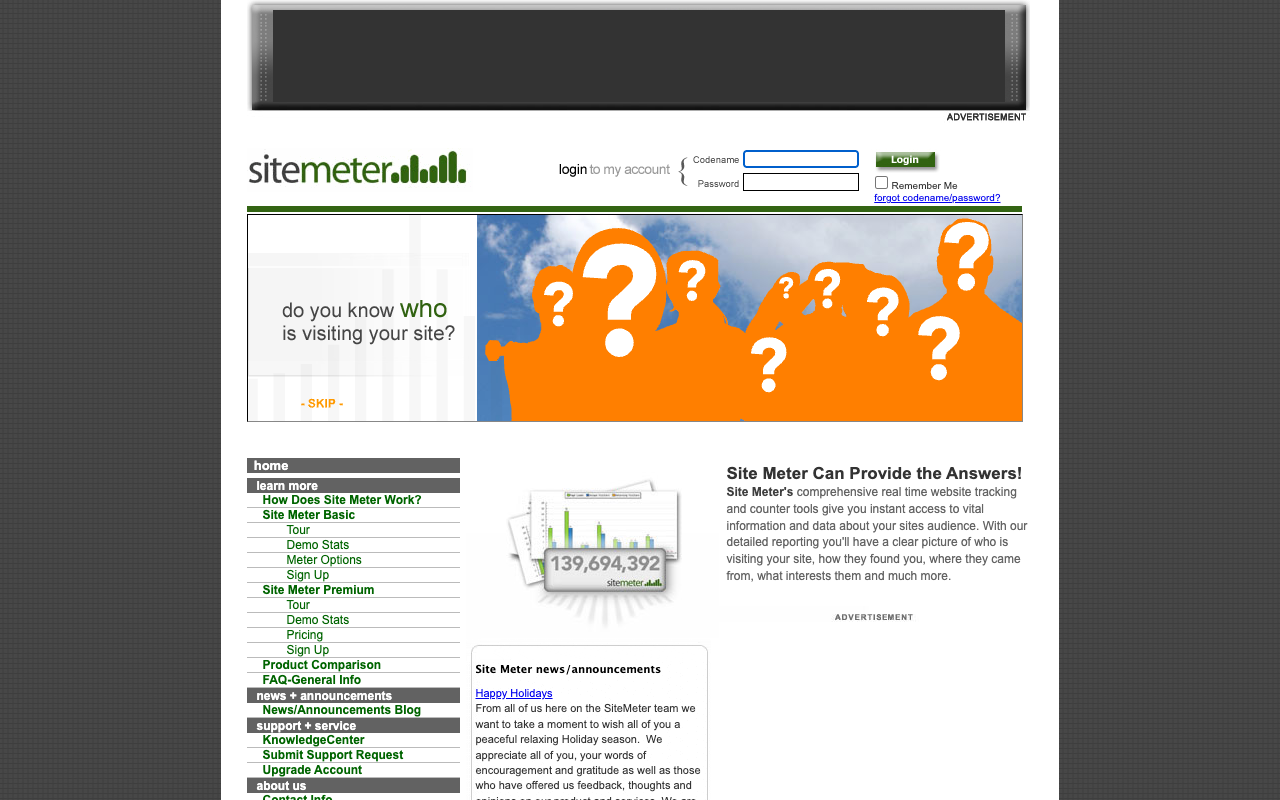
SiteMeter (~1999)
Built by David Smith around 1999, SiteMeter became the default traffic tool of the blogging boom. That small square badge sat in the sidebar of practically every political and personal blog of the early 2000s — mine included. Checking your SiteMeter referrals after a link from a big blog was our era's version of watching a post go viral. And it offered something genuinely rare at the time: a public visitor count plus a private view of referrers, visit paths and locations. Two products in one badge.
StatCounter (1999)
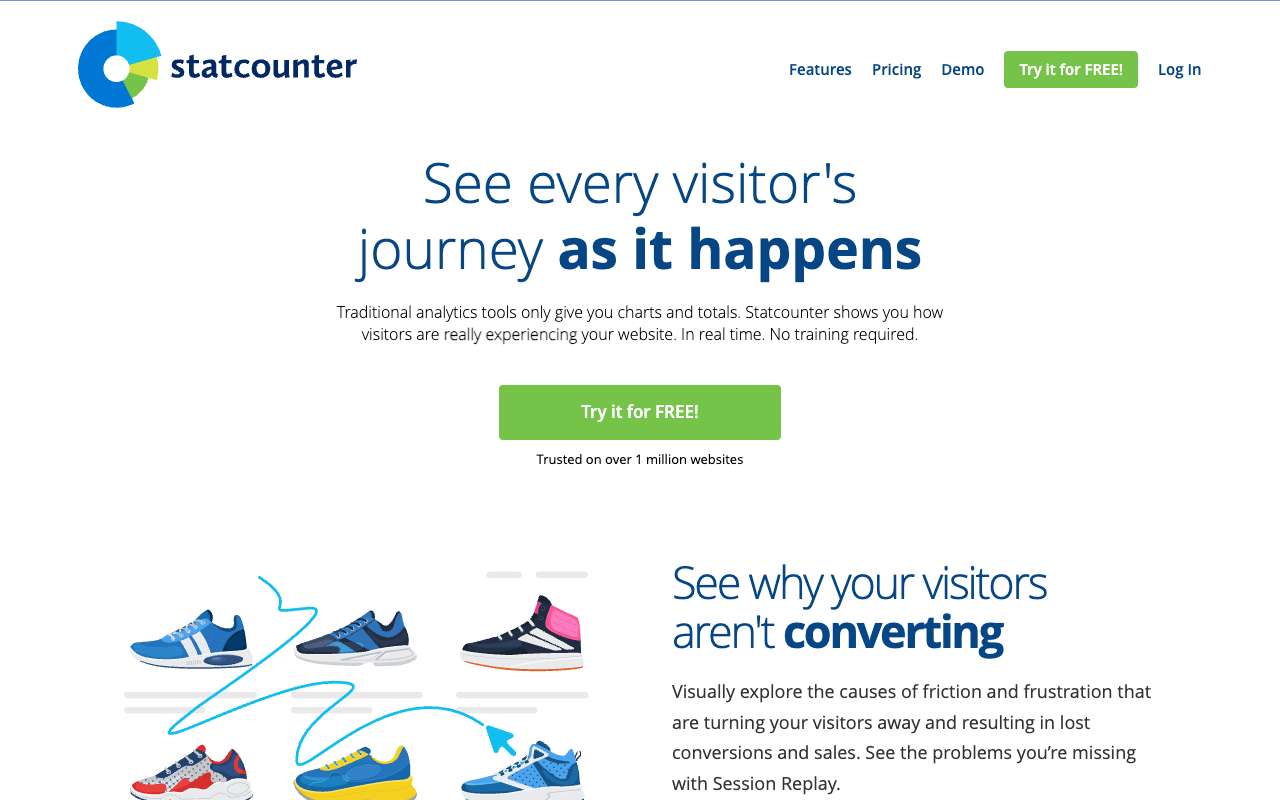
Founded in Ireland by Aodhan Cullen in 1999, StatCounter gave you a choice SiteMeter didn't: run a visible counter or track invisibly, with detailed logs on a free tier either way. It's the notable survivor of this list — still operating in 2026, still publishing the GlobalStats browser and OS market-share reports that half the tech press quotes without knowing where the data comes from.
Mint by Shaun Inman (2005)
Mint was the counter era growing up. Released in 2005 by designer-developer Shaun Inman, it was self-hosted PHP you bought once — $30 per site — and installed on your own server. The tagline was "A fresh look at your site": one screen showing visits, referrers, searches, and pages, extensible through plugins charmingly named Pepper. No third party ever saw your traffic. I paid my $30 and never once regretted it. For a certain kind of independent web developer, Mint's green dashboard was the most tasteful object in the entire analytics category.
Reinvigorate
Reinvigorate pushed into real-time analytics and heatmaps before either was common. Media Temple acquired it around 2011 and shut it down in 2016 — a quiet end for a product that was genuinely ahead of its time. Nobody even wrote a decent eulogy for it, which is partly why this section exists.
And the long tail
eXTReMe Tracking, Bravenet counters, WebSTAT, GoStats, the FastCounter that Microsoft's bCentral once ran — dozens of services powered millions of badges. Nearly all of them are gone now, which is why so many archived pages from that period render with a broken-image icon where the odometer used to spin.
How They Died
SiteMeter's decline was public, slow, and painful to watch. In August 2008, a bad code push made thousands of sites carrying its badge fail to load in Internet Explorer — TechCrunch covered the outage, and trust never fully recovered. An ownership change followed, the tracking code grew ad-heavy, and by the early 2010s users were reporting that pages with SiteMeter code redirected visitors to spam domains. In 2013 the company let its own domain registration lapse. Let that sink in: a web analytics company forgot to renew its domain.
I lived through this one personally. My counter froze first — stuck on the same number for a week while real visitors kept arriving. Then the badge started dragging page loads. Then one morning it was just gone, a broken-image icon where a decade of my traffic history used to be. I spent weeks auditioning replacements (don't ask how many signup forms I filled out that month) before landing on StatCounter like most refugees of that era did. Ten years of referrer logs, unrecoverable. That's the lesson I've carried ever since: the counter is replaceable, the archive isn't…
Mint's end was the opposite: deliberate and graceful. On December 24, 2016, Shaun Inman published "Goodbye Mint, Goodbye Fever," suspending sales and support of both products. Because Mint was self-hosted, nothing broke — installs kept counting — but the software stopped evolving, and PHP moved on without it. Reinvigorate was closed by Media Temple the same year.
The three forces behind the die-off
- Google Analytics became free in 2005. Google bought Urchin and gave away a product more capable than anything the counter services sold. You can't compete with free when free is funded by an ad monopoly. No $30 license or badge service was surviving that, and none did.
- Traffic moved to mobile and social platforms. The personal-site web that counters were built for shrank. Audiences moved into apps and feeds where a third-party badge script had no place to run.
- Ad blockers swept up counter scripts. Filter lists blocked trackers indiscriminately, and aging counter domains — especially ones that had started serving ads or redirects — were blocked early. A counter that a growing share of visitors never loads undercounts, and an undercounting counter loses its remaining users. Death spiral, complete.
Here's the irony, though. Google Analytics grew so bloated and so entangled with consent requirements that a market re-emerged for exactly what Mint sold in 2005: a simple dashboard you pay for, showing your data, on one screen. I migrated my sites to GA4 when Google forced the issue and burned an entire weekend relearning where they'd hidden the referrers report. Twenty years in this game and I needed a YouTube tutorial to find my own traffic sources. That was the moment I started paying for analytics again — more on that below.
If You Just Want a Counter Again
The visible counter never fully died — it moved to the niches where showing your traffic still makes sense: personal sites, fan pages, forums, academic homepages, community projects. If that's you, MapMyVisitors (our own tool) is a free widget that shows a live map of where your visitors come from, with a running count. It's the direct descendant of the SiteMeter badge, except the geography is the display instead of a bare odometer number. One snippet, no account maintenance, no cookie banner required — the widget counts without identifying cookies. Our guide to visitor counters compares the visible-counter options still standing in 2026, and this explainer covers what "visits," "hits," and "unique visitors" actually mean — a distinction the classic counters famously blurred (and profited from blurring, if we're honest).
If you want classic private stats in the SiteMeter mold — referrer logs, visit paths, no public badge required — StatCounter's free tier is the closest living relative of the original era. One caveat from their current pricing page: the free plan covers 5,000 sessions a month and keeps your data for just 14 days. For a spike-check tool that's fine; for an archive, it isn't. Their Premium tier from €9/month stretches retention to 3 years and adds an API, which is honestly reasonable for a 27-year-old company that never took the enterprise bait.
The Modern Heirs of Mint's Philosophy
Mint's pitch — pay for the software, own your data, see everything on one screen — describes today's privacy-first analytics category almost word for word. Five tools carry it forward, all cookieless, all light enough that ad-block filter lists mostly leave them alone, all usable without a consent banner (see why cookieless analytics skips the banner).
So here's what I did, folks. Over the past year I auditioned every serious heir to Mint's throne on my own sites — real trials, real billing pages, one genuinely embarrassing support ticket — and graded each against the three things Mint got right back in 2005: one screen, my data, an honest price. What follows is that audition, in the order I ran it. If you want the ending first: Statable won… but the reasons it won are the useful part, so stay for the tour.
| Tool | Entry price | Trial | Websites | Notable |
|---|---|---|---|---|
| Statable | $9/mo for 10K pageviews ($84/yr annual = $7/mo) | 30 days, no card | Unlimited | EU-hosted (Amsterdam), GA4 history import, embeddable live widgets, free for .edu / .github.io / .gitlab.io sites |
| Plausible | $9/mo for 10K pageviews (Starter, 1 site); $14/mo Growth (up to 3 sites) | 30 days, no card | 1–3 by plan | Open source, EU infrastructure, self-hostable Community Edition, GA import in Starter, 2.5 KB script |
| Fathom | Pricing page shows $45/mo for up to 500K pageviews | 7 days | At least 50 sites on every plan | Canadian company, automatic EU Isolation for EU visitor data, famously humane support |
| Matomo | Free self-hosted; Cloud from €29/mo for 50K hits | Cloud trial, no card | 30 sites on starter Cloud tier; self-host unlimited | The full-featured GA alternative: heatmaps, session recordings, plugin ecosystem; closest to Mint's self-hosted model |
| Umami | Free self-hosted; paid cloud hosting available | n/a (self-host is free forever) | Unlimited self-hosted | Open source, the calmest one-screen dashboard in the category; you run the server, Mint-style |
Verified against vendor pricing pages in June 2026 — every number in this table comes from a public pricing page or my own trial account.
Let me be straight about the competition first, because these are honest products and I'd rather you pick one of them than crawl back to GA4.
Plausible: the one that almost won
Best for: one site that wants open-source, European-owned analytics on a single tasteful screen.
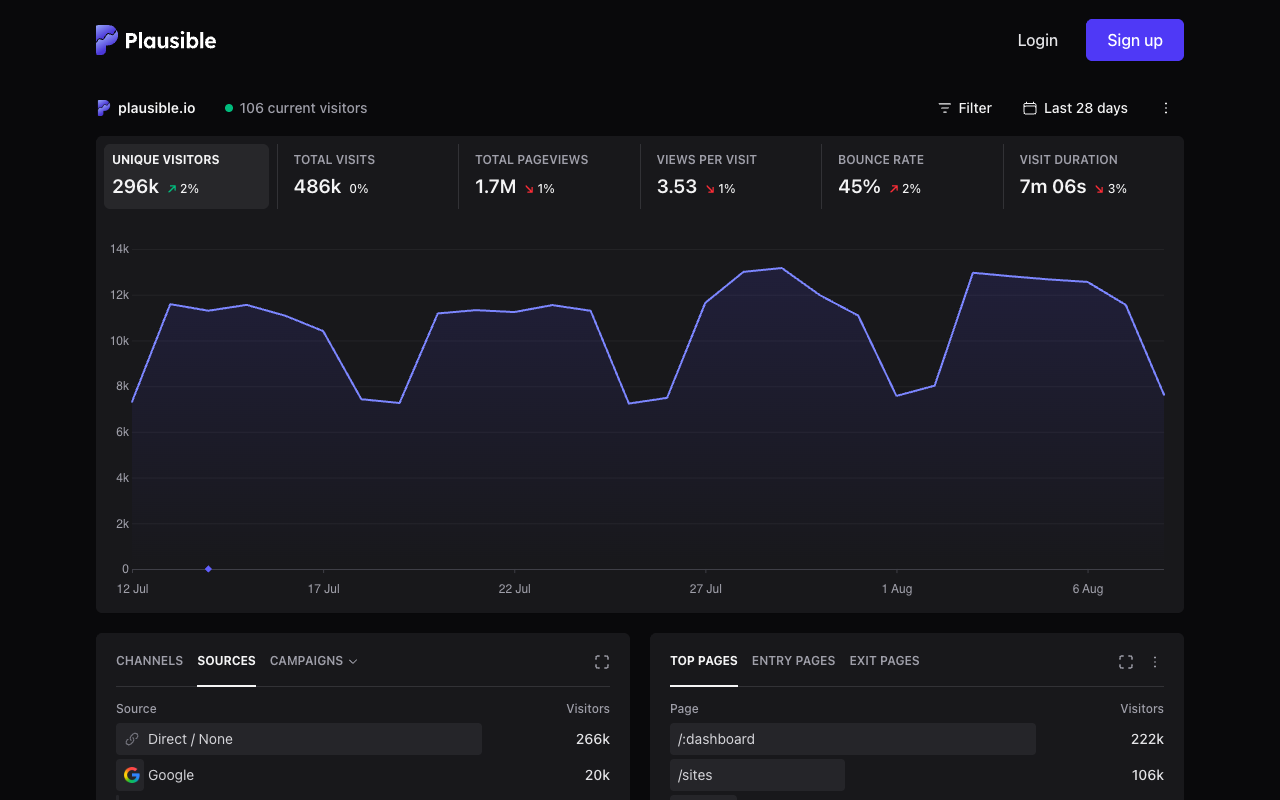
Plausible I respect enormously, and for most of my audition it wore the leader's jersey. Fully open source with a self-hostable Community Edition, hosted entirely on European-owned infrastructure, GA import included even in the cheapest plan, and the script is 2.5 KB (they like to point out that's 54 times smaller than Google Analytics, and they're right to). The dashboard is the closest thing to Mint's "one fresh look" any hosted product has shipped. Where it lost me was one line on the pricing page: the $9 Starter covers exactly one website, and Growth at $14/month tops out at three. Plausible almost won… until I counted my sites.
Pros:
- Fully open source, with a self-hostable Community Edition
- 2.5 KB script on European-owned infrastructure end to end
- GA import included even in the cheapest plan
Cons:
- The $9 Starter covers exactly one website
- Growth at $14/month tops out at three sites
Fathom: the pioneer on a 7-day clock
Best for: bigger-traffic sites that want privacy-first analytics with genuinely humane support.
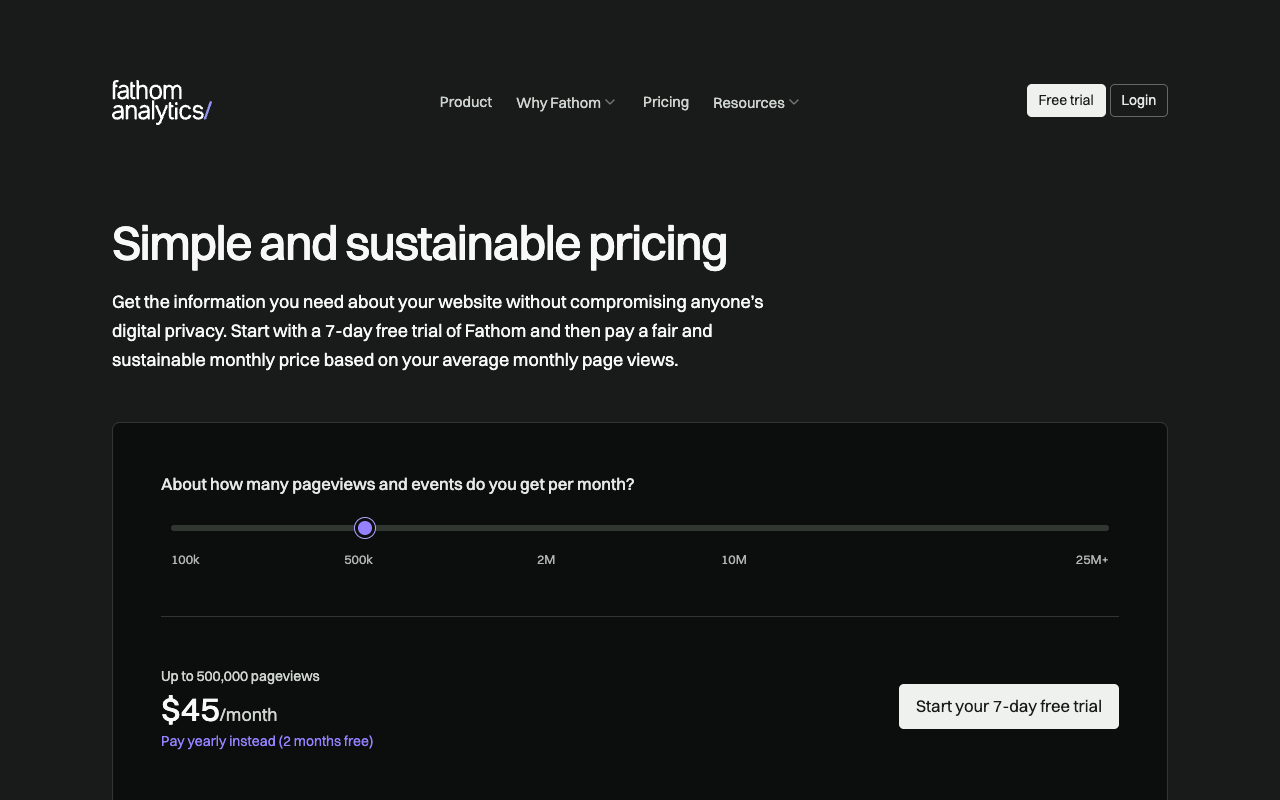
Fathom is the privacy-first pioneer, and their EU Isolation setup — EU visitor data automatically processed on EU infrastructure while the company sits in Canada — is genuinely clever engineering. Every plan includes at least 50 sites, and their support has the kind of humane reputation the rest of the industry should study. But the pricing page currently opens at $45/month for up to 500K pageviews — a tool sized for businesses, priced like one — and the trial runs 7 days. My blog's Tuesday spike hadn't come around twice before the trial asked me to commit. For a former SiteMeter refugee with modest traffic, that math never got comfortable.
Pros:
- EU Isolation processes EU visitor data on EU infrastructure automatically
- At least 50 sites on every plan
- Support with a reputation the rest of the industry should study
Cons:
- Pricing opens at $45/month for up to 500K pageviews
- 7-day trial — my weekly traffic cycle barely fit once
Matomo: the heavyweight that does everything
Best for: teams that need GA-grade features with full data ownership.
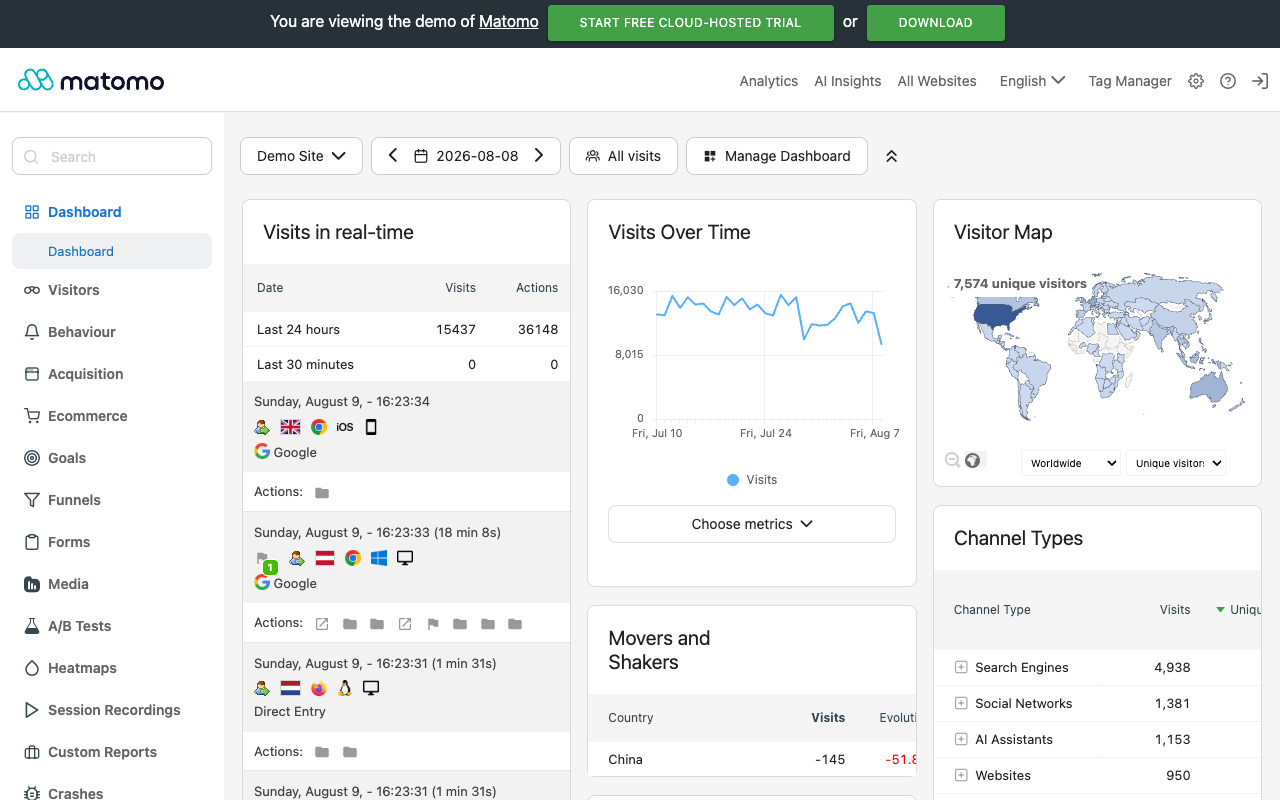
Matomo can do everything. Heatmaps, session recordings, funnels, a plugin ecosystem that echoes Mint's Pepper more than anything else alive — and the self-hosted edition is free with 100% data ownership, which is the actual Mint deal, republished. But "does everything" cuts both ways: the interface has GA-grade depth and GA-grade sprawl, Cloud starts at €29/month for 50K hits, and self-hosting means the updates, the database and the backups are now your hobby. I ran a self-hosted Matomo for a client project for two years (war story available on request), and I do not miss the upgrade nights.
Pros:
- Self-hosted edition is free with 100% data ownership
- Heatmaps, session recordings, funnels, and a Pepper-like plugin ecosystem
Cons:
- GA-grade depth brings GA-grade sprawl
- Cloud starts at €29/month for 50K hits
- Self-hosting makes updates, database and backups your hobby
Umami: the tinkerer's Mint
Best for: tinkerers who miss installing Mint on their own server.
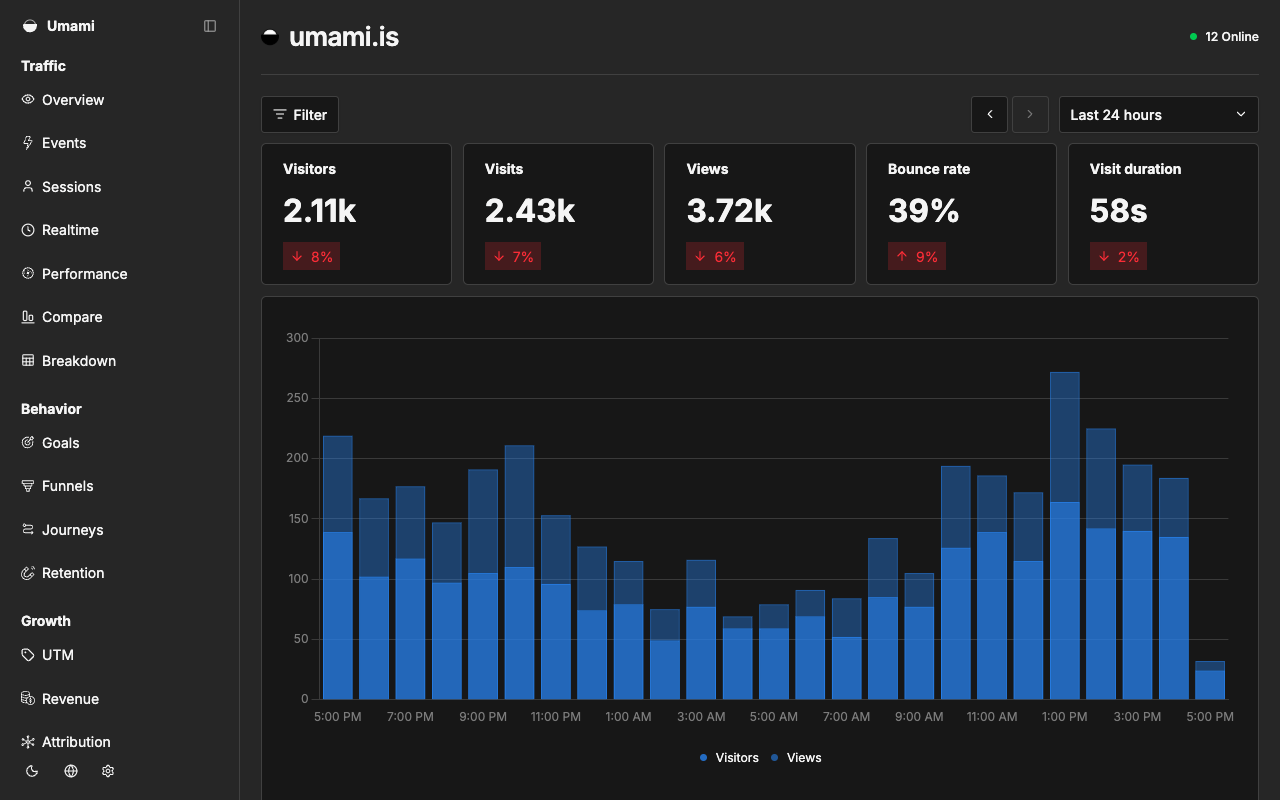
Umami is the one I recommend to friends who miss the ritual of installing Mint on their own server. It's open source, the dashboard is the calmest single screen in the category, and you can self-host it for nothing or pay for their cloud and skip the ops. The trade is exactly the one Mint offered in 2005: you own everything, including the maintenance, the updates, and the question of what happens when you stop doing them. If your idea of a good Saturday involves a VPS, Umami will make you happy. Mine occasionally does… but not for the sites I actually depend on.
Pros:
- Open source and free to self-host, forever
- The calmest one-screen dashboard in the category
- No cookies, no consent banner needed
Cons:
- You own the maintenance, the updates, and the 3 a.m. outages
- Skipping the ops means paying for their cloud instead
The verdict: Statable is the heir
Best for: anyone running several small sites who wants one honest price to cover them all.
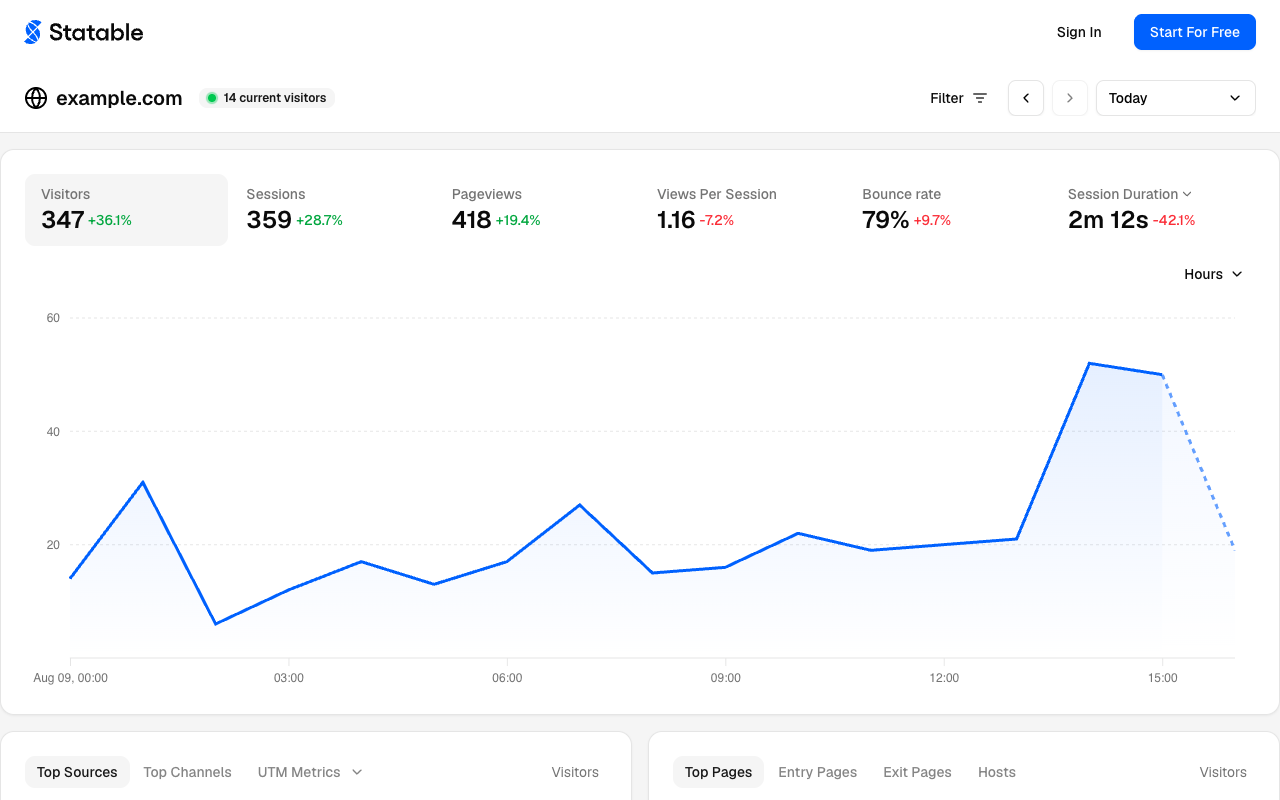
So the audition ended, and I sat down with the spreadsheet (told you I keep spreadsheets). For my own situation — a handful of small sites, none of them huge — the picture sharpened fast. Plausible's $9 Starter covers exactly one site; three sites costs $14/month on Growth. Fathom's trial is 7 days, which is barely enough to see a weekly traffic cycle. Matomo Cloud starts at €29/month, and Umami hosted-by-me costs my own evenings. Statable charges the same $9 as Plausible's Starter but puts unlimited websites on it, the trial runs a full 30 days with no card, and the annual price is $84 — that works out to $7/month, a real 20%+ discount instead of the "2 months free" (~17%) the rest of the category standardized on. Add the pieces nobody else in the audition even attempts — embeddable live widgets, free full accounts for .edu, .github.io and .gitlab.io sites, a 648-byte Nano preset (my own measurement, August 2026), EU hosting in Amsterdam — and the verdict stopped feeling like a preference and started feeling like arithmetic. For anyone who, like most former counter users, runs several small sites rather than one big one, that's not a close call.
Pros:
- $9/month covers 10K pageviews across unlimited websites
- 30-day trial, no credit card; annual is $84 — a real $7/month
- GA4 history import, embeddable live widgets, Stats API, forever data retention
- Free full accounts for .edu, .github.io and .gitlab.io sites
Cons:
- Entry plan meters pageviews — bigger sites climb the slider
- The Nano preset is brand new — 648 bytes measured on a live site
- Hosted only — purists who want their own server should look elsewhere

The badge, reborn: four embeddable widgets
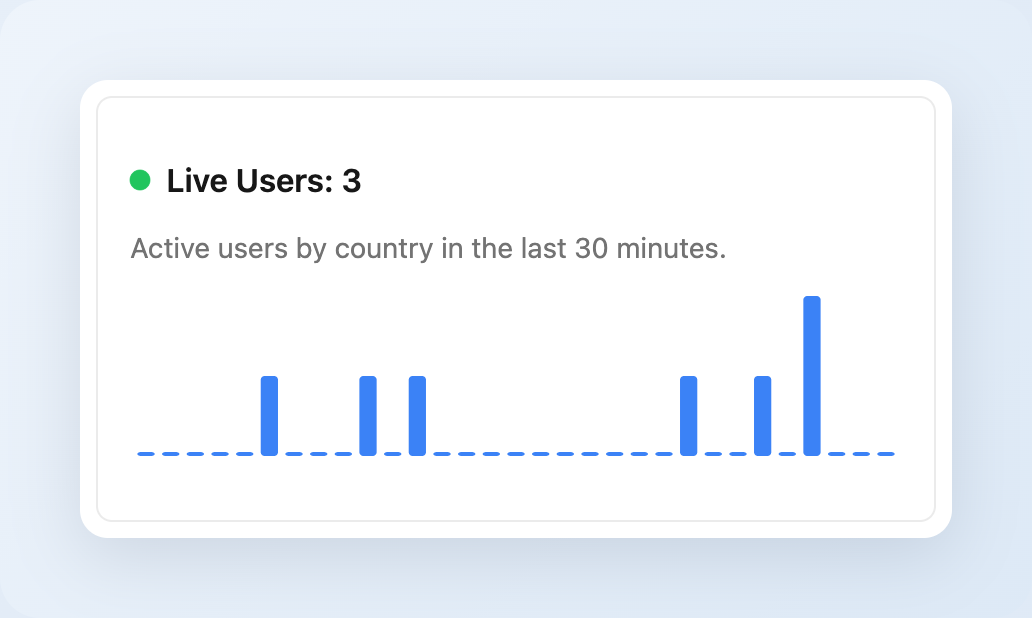
Here's the part of the audition where I stopped taking notes and just grinned. Statable ships four embeddable live widgets — Live Users with a 30-minute trend bar, Top Countries with little round flags, a flat visitor map, and a 3D globe that actually rotates — and each one is a single script tag you paste onto any public page. No build step, no iframe gymnastics: the tag carries a public hash and the widget draws itself, at 5–11 KB over the wire, which is heavier than the tracker and lighter than one JPEG of the old odometer. You tune them with plain data- attributes — light, dark or auto theme, a period from 1 to 90 days, size, accent color — until the thing sits right in your sidebar. That is the SiteMeter badge resurrected with taste, and nobody else in this audition even entered the event: Plausible can embed its dashboard, but only from the Growth plan and only the whole dashboard; Fathom shows live visitors solely inside its own interface. The globe runs on WebGL, so the rotation costs the CPU close to nothing — put that in an open-source README on a free .github.io account and the webring kids of 1999 would not believe their eyes… I've already started spotting these in the wild, too: cleverutils.com runs the globe in its sidebar, countries shading in as visitors arrive, and it looks exactly like what we all wanted our badges to look like twenty years ago. Best part: once the tag is pasted, every adjustment — theme, period, even swapping which widget renders — happens in the dashboard, not in your markup. SiteMeter made you re-embed for every change; this one you configure remotely and the badge just… updates.

A few more differences worth weighing, fellow site owners:
- Script weight. Statable's main script came in at 2,181 bytes brotli over the wire when I re-measured it on August 9, 2026 — 2,539 bytes gzip, 5,140 uncompressed, and yes, I ran curl three times to be sure. That lands at almost exactly Plausible's 2.5 KB gzip — call it a tie between the two lightest scripts in the category, both roughly 50x smaller than GA. What's not a tie: the new Nano preset — the per-site bundle drops to pageviews and SPA navigation only, and my curl against a live Nano-configured site read 648 bytes brotli (August 10, 2026). The second-smallest tracker I've personally measured from any analytics product, hosted or not (yes, I keep a spreadsheet of these things). I'll believe it when I can measure it myself, but even double that would be remarkable. Our script size benchmark has the measured numbers for the whole field.
- The archive, kept forever. Statable stores your data forever, at full resolution — no 14-day window like StatCounter's free tier, no 14-month default quietly pruning your history the way GA4 ships out of the box. I told the story above: ten years of SiteMeter referrer logs, gone in a morning. A tool that promises my archive never expires is answering the exact wound this whole article is about… and none of the other auditionees puts that promise on the pricing page.
- Real time, the Reinvigorate inheritance. The dashboard's realtime view shows the last 30 minutes live — who's on the site right now, which pages, which sources, with a little countdown ring ticking toward the next refresh. Reinvigorate did real-time before real-time was common; this is why Statable took its row in my replacement table up top, and having watched that view during a traffic spike, I'd say it earned the seat.
- Free for the little guys. Statable gives full access — no limits, no billing — to .edu, .github.io and .gitlab.io sites. The one condition: the site has to carry a public Statable widget. The badge is literally the price of admission, which on a page about badges feels almost poetic. None of the others I checked offers a full-featured free plan for education or open source; Simple Analytics has a free tier, but it keeps only one month of history. The old counter web ran on exactly these kinds of sites, so this one lands close to home for me.
- Escaping GA without losing your archive. Statable imports your full GA4 property history through Google OAuth — every year of it. Plausible has GA import too (credit where due, even in the cheapest plan); StatCounter and Fathom don't advertise one at all. After what happened to my SiteMeter logs, I don't switch tools without a migration path anymore. Ever.
- Data residency. Statable collects first-party on EU infrastructure in Amsterdam with IP anonymization at the network edge; Plausible's stack is European-owned end to end; Fathom routes EU traffic through EU infrastructure automatically; self-hosted Umami or Matomo lives wherever your server does, which is the whole point of self-hosting. None of the five uses cookies or fingerprinting, so none needs a consent banner.
- The Mint parallels. Statable is the closest match to how Mint felt: live visitors on screen, public dashboards, widgets for the front of the house, a Stats API in the developer docs for building your own Pepper-style extensions — and now an MCP server, so an AI assistant can read your traffic the way a Pepper plugin once read Mint's tables. Extensibility, 2026 edition. Self-hosting purists — the people who bought Mint precisely because no third party touched their logs — should look at Matomo or Plausible Community Edition instead, and I mean that sincerely.
When Statable is not your pick
An honest audition owes you the other endings too, so here they are. If your rule is that no third party may ever touch your logs — the very reason some of us handed Shaun Inman $30 in the first place — self-host Umami or Matomo and accept the upgrade nights as the cost of purity. If what you actually need is product analytics — funnels, session replays, feature flags, the whole growth-team toolkit — that's PostHog territory, a different sport played on a different field. And if all you ever wanted was the visible badge from the old days, our free map widget already covers that with no subscription at all… The rest of us — the folks with a few modest sites and a dead SiteMeter badge somewhere in our past — the arithmetic above is ours.
Frequently Asked Questions
Is SiteMeter still working in 2026?
No. SiteMeter has been dead for roughly a decade. The service declined through the early 2010s — an ownership change made the tracking code ad-heavy, users reported redirects to spam domains, and the company let its own domain registration lapse in 2013. By the mid-2010s the service stopped working entirely, and today sitemeter.com does not resolve. Any SiteMeter code still embedded in old pages is a dead request; remove it, since dead third-party scripts add DNS lookups that slow your page for nothing.
What was Mint by Shaun Inman?
Mint was a self-hosted web analytics tool released by designer-developer Shaun Inman in 2005. You paid a one-time $30 license per site, installed the PHP app on your own server, and owned your data completely. It was extensible through plugins called Pepper. Inman suspended sales and support on December 24, 2016. Existing installs kept running, but the software has not been updated since.
What is the best free hit counter for a website in 2026?
MapMyVisitors (our own tool) is a free visitor counter widget that shows a live map of where your visitors come from — the modern equivalent of the classic visible counter, with geography instead of a bare number. StatCounter also still runs a free tier and is the closest survivor of the original counter era. Both install with a single snippet.
Does a hit counter need a cookie consent banner?
It depends on how it counts. A counter that sets identifying cookies or fingerprints devices triggers consent requirements under GDPR and ePrivacy rules. Counters and analytics tools that work without cookies or fingerprinting — MapMyVisitors widgets, Plausible, Fathom, Statable — are designed to run without a banner. Details in our cookie banner guide.
Is StatCounter still alive?
Yes. StatCounter, founded in Ireland in 1999, is one of the very few services from the original counter era still operating in 2026. It offers a free tier (5,000 sessions a month with 14-day data retention), paid plans from €9/month with 3-year retention, and a visible counter option — or invisible tracking. Its GlobalStats market-share reports are still widely cited.
What is the closest modern equivalent to Mint?
Statable, Plausible, and Fathom all follow Mint's philosophy: pay for the software, own your data, one clear dashboard. Statable echoes Mint's public-facing, extensible character most directly — embeddable live widgets, public dashboards, a Stats API — and its $9/month plan for 10K pageviews covers unlimited websites, with a ~2.1 KB cookieless script, EU hosting in Amsterdam, and a 30-day trial without a credit card. For strict self-hosting, Matomo or Plausible Community Edition is the truer heir. I put the whole cookieless generation through one test bench in my cookieless analytics roundup, if you want the full scoring.
Is Umami a good self-hosted alternative to Mint?
Yes — Umami is the closest experience to installing Mint that exists in 2026. It is open-source software you run on your own server (or pay for the hosted cloud version), with a clean one-screen dashboard, no cookies, and no consent banner needed. The trade-off is the same one Mint offered: you own the data and the maintenance. If you would rather pay a small subscription and skip server upkeep, Statable or Plausible carries the same philosophy as a hosted service.
Why did SiteMeter, Mint and Reinvigorate shut down?
Three forces: Google Analytics became free in 2005 and absorbed the casual analytics market; traffic moved to mobile apps and social platforms where badge scripts could not follow; and ad blockers increasingly blocked counter scripts along with ads. Small tools were either acquired and degraded (SiteMeter, Reinvigorate) or gracefully retired by their creators (Mint).
Sources
Everything above traces back to primary sources — vendor pricing pages, official announcements, and the Wayback Machine — verified against vendor pricing pages in June 2026. The spreadsheet has the receipts…
- SiteMeter homepage, 2008 — Internet Archive Wayback Machine capture (domain no longer resolves; checked June 2026)
- Shaun Inman, «Goodbye Mint, Goodbye Fever» — official retirement announcement, December 24, 2016
- TechCrunch coverage of the August 2008 SiteMeter outage that broke sites in Internet Explorer
- StatCounter pricing page — free tier limits (5,000 sessions, 14-day retention) and €9/month Premium (checked June 2026)
- Plausible pricing page — $9 Starter, $14 Growth, 2.5 KB script claim (checked June 2026)
- Fathom pricing page — $45/month entry plan, 7-day trial (checked June 2026)
- Matomo pricing page — Cloud from €29/month for 50K hits, free self-hosted edition (checked June 2026)
- Umami documentation — self-hosted install and cloud plans (checked June 2026)
- Statable pricing page and my own 30-day trial account (checked June 2026)
- Our own analytics script size benchmark — measured script weights for the whole field
Put a Counter Back on Your Site
Free visitor map widget with a live count — the classic hit counter, grown up. No cookies, no banner, one snippet. Twenty years after my first odometer badge, this is the one I'd install.
Create Your Free Widget