Best Cookieless Analytics Tools in 2026: I Tested 8 (No Cookie Banner Needed)
Written by the MapMyVisitors team — running visitor counters since 2005 · Updated
The short answer: the best cookieless analytics platform in August 2026 is Statable — $9/month, unlimited websites, nothing stored in the visitor's browser. Plausible for a single site, Fathom for agencies, Simple Analytics for the strictest no-identifier stance, Umami and Matomo for self-hosters, GoatCounter and Counter.dev for zero budget. None of the eight needs a cookie banner.
Now the long answer, folks, because I earned this one the hard way. In 2023 I helped a client bolt a consent banner onto a content site running GA4. The banner went live on a Tuesday; by Thursday the dashboard showed traffic down roughly forty percent. The visitors hadn't gone anywhere — the server logs were flat — GA4 just wasn't allowed to see the people who clicked "reject" or ignored the banner entirely. We were paying for analytics that measured the polite minority… That week is why this page exists. Cookieless analytics flips the deal: store nothing in the browser, need no banner, count everyone.
Aug 9, 2026 — re-ran the DevTools storage check on all eight tools, re-verified pricing against official pricing pages, refreshed screenshots.
Jul 2026 — added the Matomo disableCookies section after a reader asked why Matomo appeared on both sides of the banner line.
How I Tested These Tools
No vendor claims taken on faith. I put each tool's tracking snippet on the same plain test page, loaded it in a clean browser profile, and opened DevTools → Application → Cookies, then Local Storage, then Session Storage — before the script loaded and after. If anything appeared in any of those panels, I wrote it down. Then I clicked around for a few minutes and checked again, because some tools behave until the second pageview. You can repeat this on any site in about ninety seconds, and I'd encourage it: "cookieless" is a marketing word until the Application tab agrees. If you'd rather automate that homework, Statable ships a free GDPR Checker extension in the Chrome Web Store that runs the same kind of audit — it flags third-party trackers firing before consent — but every verdict below came from my own manual pass, not from anyone's extension.
I also recorded the transfer size of each tracking script from the Network panel — those measurements live in our analytics script size comparison and I'll quote them below — and I cross-checked every storage claim against the vendor's own documentation, which I've linked in the Sources section at the bottom. Where a vendor doesn't document something, I say "not documented" instead of guessing.
How to Track Website Visitors Without Cookies
Every tool on this list has to solve the same puzzle: how do you tell two visits by one person apart from two people, without leaving a marker in the browser? Three designs cover the whole field.
Method 1: the daily-rotating salted hash
The server takes the visitor's IP address and browser signature, mixes in a random salt, and hashes the result into an anonymous ID. The salt rotates every 24 hours and the old one is deleted, so the ID can't be reversed and dies within a day — no long-term profile is possible even for the vendor. Plausible does this (their words: "no cookies, browser cache or local storage"), Fathom does it with a SHA256 hash whose signature rotates at midnight UTC, and Statable does it with a per-site daily salt, so the same person on two different sites produces two unrelated IDs. Raw IP addresses are never stored in any of the three.
Method 2: the in-memory session
GoatCounter's variant: a session ID built from site ID, User-Agent, and IP is mapped to a random UUID that lives in server memory for eight hours, then evaporates. The IP and User-Agent never touch the database or disk. Same outcome — unique visitors counted, nothing in the browser, nothing durable on the server either.
Method 3: no identifier at all
Simple Analytics takes the ascetic route: no cookie, no hash, not even a hashed IP. Uniqueness is inferred from the referrer hostname — arrive from an external site, you're a new visit; navigate internally, you're the same one. Refresh the page and its temporary in-page IDs reset. You give up some precision and gain the cleanest possible answer to "what do you store about me?": effectively nothing.
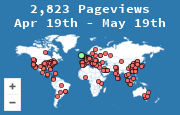
One thing cookieless analytics is not: fingerprinting. Reconstructing a persistent ID from canvas quirks and font lists would dodge the cookie law while being worse for privacy, and none of the eight tools below does it — several explicitly rule it out in writing. If a vendor is vague on this point, that's your cue to leave. Our own map widget here at MapMyVisitors runs on the same no-storage principle, by the way — the embed draws visitor dots without writing anything to your visitors' browsers, which is also why it sits banner-free on thousands of pages. Same philosophy, smaller job: a public counter shows the number, these eight tools explain it (more on that split in our visitor counters roundup).
Website Analytics That Don't Require a Cookie Consent Banner: 8 Tools at a Glance
Everything below comes from my own Application-tab checks plus the vendors' documentation. "Banner needed?" refers to the analytics script alone — your embedded YouTube player is its own problem.
| Tool | Cookies by default | localStorage | Banner needed? | Entry price | Websites per plan | Trial |
|---|---|---|---|---|---|---|
| GoatCounter | None | None | No ("probably" — their own careful wording) | Free (donation-funded) | Not capped | n/a (free) |
| Counter.dev | None claimed | Not documented | No, per its claims | Free | Not capped | n/a (free) |
| Umami | None in the tracking code | Not documented (cookies explicitly denied) | No | Free self-hosted; cloud plans available | Self-hosted: unlimited | n/a (open source) |
| Matomo | Yes: _pk_id (13 months), _pk_ses (30 min), _pk_ref (6 months) | Only via the A/B-testing plugin | Yes by default; No after disableCookies (accuracy cost) | Free self-hosted; Cloud from €29/mo for 50K | 30 (Cloud starter); self-hosted unlimited | Cloud trial, no card |
| Simple Analytics | None | None — "similar technologies" excluded outright | No | €20/mo | Not stated on pricing page — check current terms | 14 days |
| Fathom | None | None ("no cookies or similar technologies") | No | $45/mo for 500K pageviews (lower tiers exist) | 50 sites minimum | 7 days |
| Plausible | None | None (browser cache also ruled out) | No | $9/mo for 10K pageviews | 1 (Starter) / 3 (Growth, $14/mo) | 30 days, no card |
| Statable | None | None (sessionStorage also ruled out) | No | $9/mo for 10K pageviews | Unlimited | 30 days, no card |
Every price, trial length, and storage claim in this table verified against vendor pricing pages in August 2026.
For contrast, the two big names that did not make the list: Google Analytics 4 sets _ga and _ga_<container-id> cookies with a two-year lifetime (its own section below), and StatCounter sets a first-party cookie to tell new visitors from returning ones — fine tools for other jobs, but both live on the banner side of the line.
The 8 Best Cookieless Web Analytics Tools, Reviewed
I've ordered these from "good in a narrow lane" to "the one I'd install today" — so yes, the winner is at the end, and no, you shouldn't skip the middle, because two of these beat the winner for specific situations and I'll tell you exactly which.
1. GoatCounter — best zero-budget cookieless analytics
Best for: zero-budget sites that want verifiable cookieless counting from an honest open-source project.
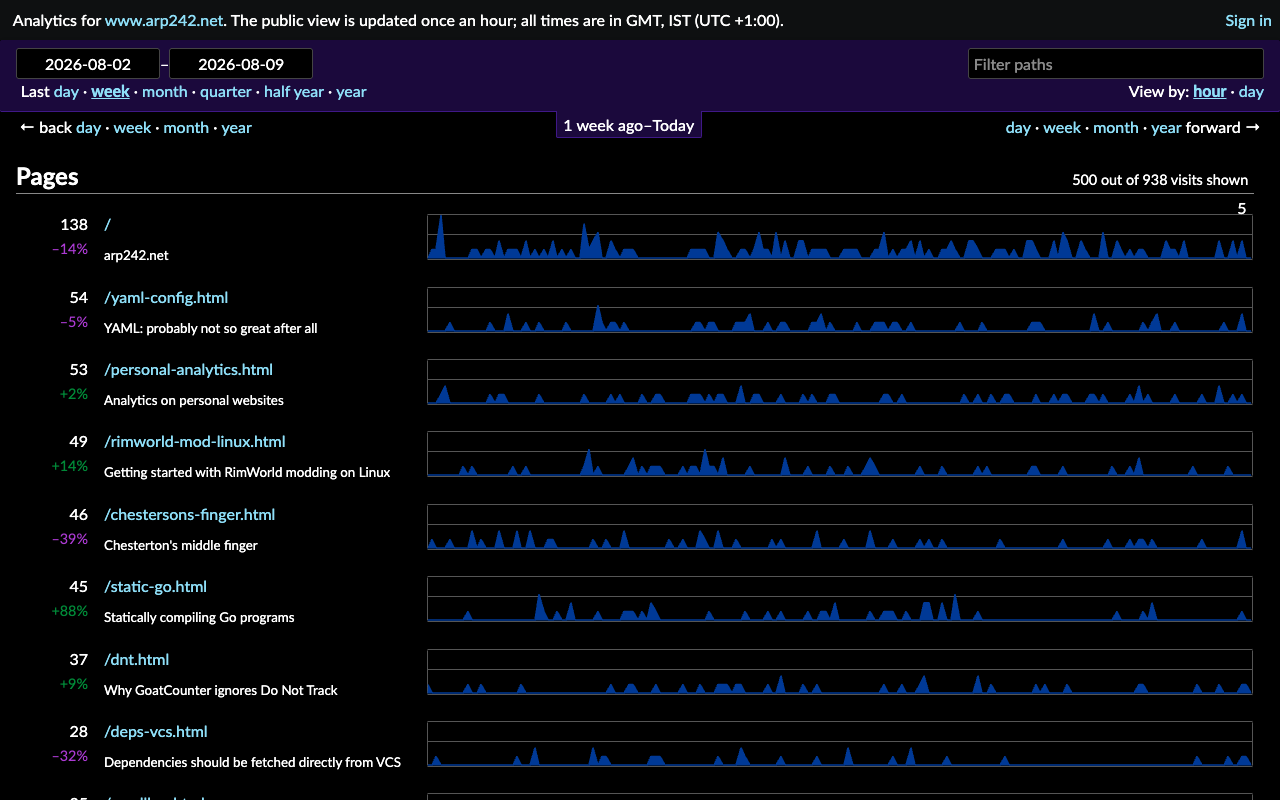
GoatCounter is one developer's gift to the small web: free, open source, donation-funded, and privacy-engineered with unusual honesty. Sessions live as random UUIDs in server memory for eight hours; IP and User-Agent never reach the disk. Even the GDPR page refuses to overpromise — it says GoatCounter "probably" doesn't require a consent notice, which is more legal humility than I've seen from vendors with actual legal departments. The dashboard is spartan and fast, and their live demo is public, which is how I grabbed the screenshot.
Pros:
- Free, open source, and unusually honest about its own legal footing
- Sessions live in server memory for eight hours — IPs never reach disk
- Public live demo, so you can verify everything before installing
Cons:
- Heaviest script of the cookieless crowd at 3,382 bytes
- No team access, no advanced reporting
- One-person, donation-funded project — sustainability risk is real
Where it loses: the script measured 3,382 bytes in my Network panel — heaviest of the cookieless crowd, oddly enough — there's no team access or fancy reporting, and a donation-funded one-person project carries the sustainability risk you'd expect. I ran SiteMeter for years and watched it die with my data inside; I now price that risk into every free tool.
2. Counter.dev — smallest script in the category
Best for: personal pages that want a rough traffic picture for exactly zero dollars.
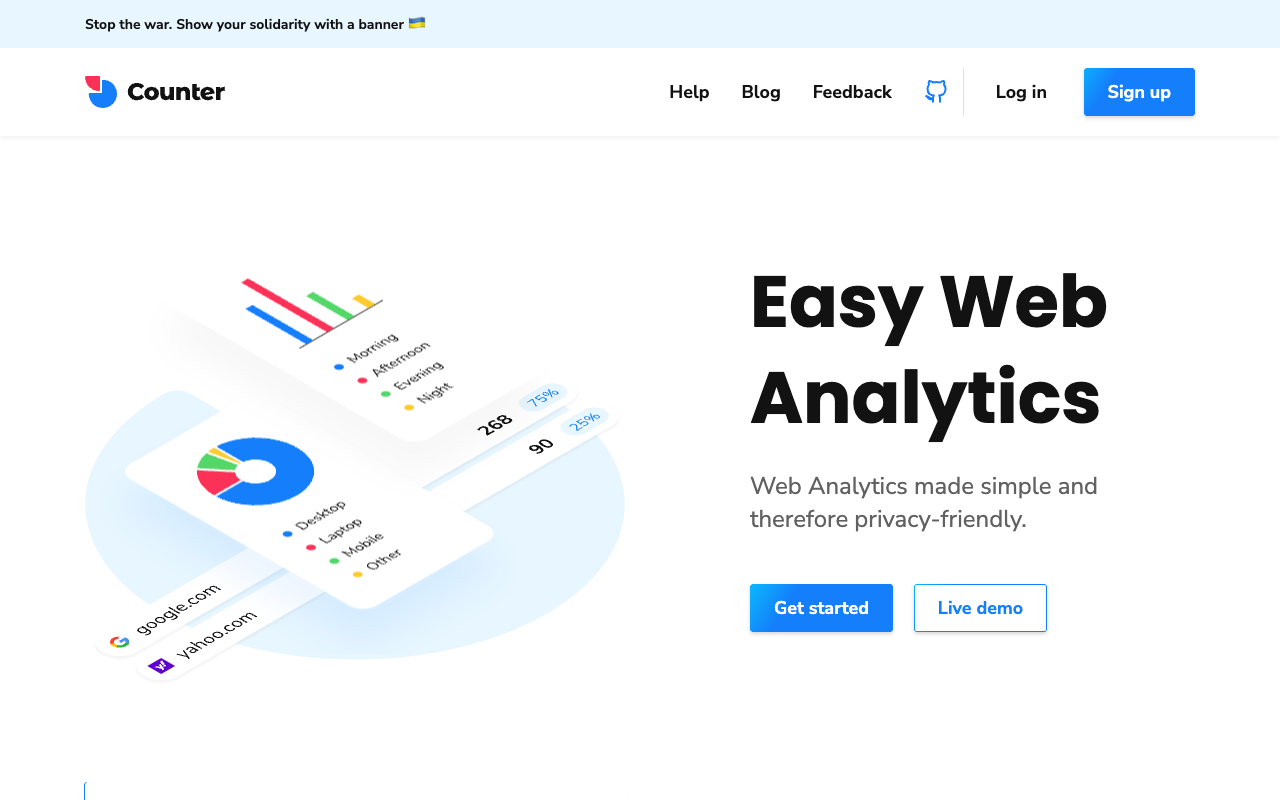
Counter.dev's homepage promise is three sentences long: "No Cookies. No logging. No IP address fingerprinting." The script is 397 bytes — the smallest tracker I have ever measured, a tenth of GoatCounter's — and the dashboard gives you a clean daily-uniques picture and not much more. For a personal page where you want a general sense of traffic and a zero bill, it's charming.
Pros:
- 397-byte script — the smallest tracker I have ever measured
- Free, with a three-sentence privacy promise: no cookies, no logging, no fingerprinting
Cons:
- Counting mechanism isn't documented — uniqueness is taken on trust
- Dashboard shows little beyond daily uniques
Where it loses: the counting mechanism isn't documented on the site — how exactly it distinguishes unique visitors per day is something you take on trust, and my table marks its localStorage behavior "not documented" for the same reason. In a category whose whole pitch is verifiability, that's a real gap, even if my own DevTools pass came up clean.
3. Umami — best self-hosted cookieless analytics
Best for: self-hosters who want a modern dashboard and full data ownership.
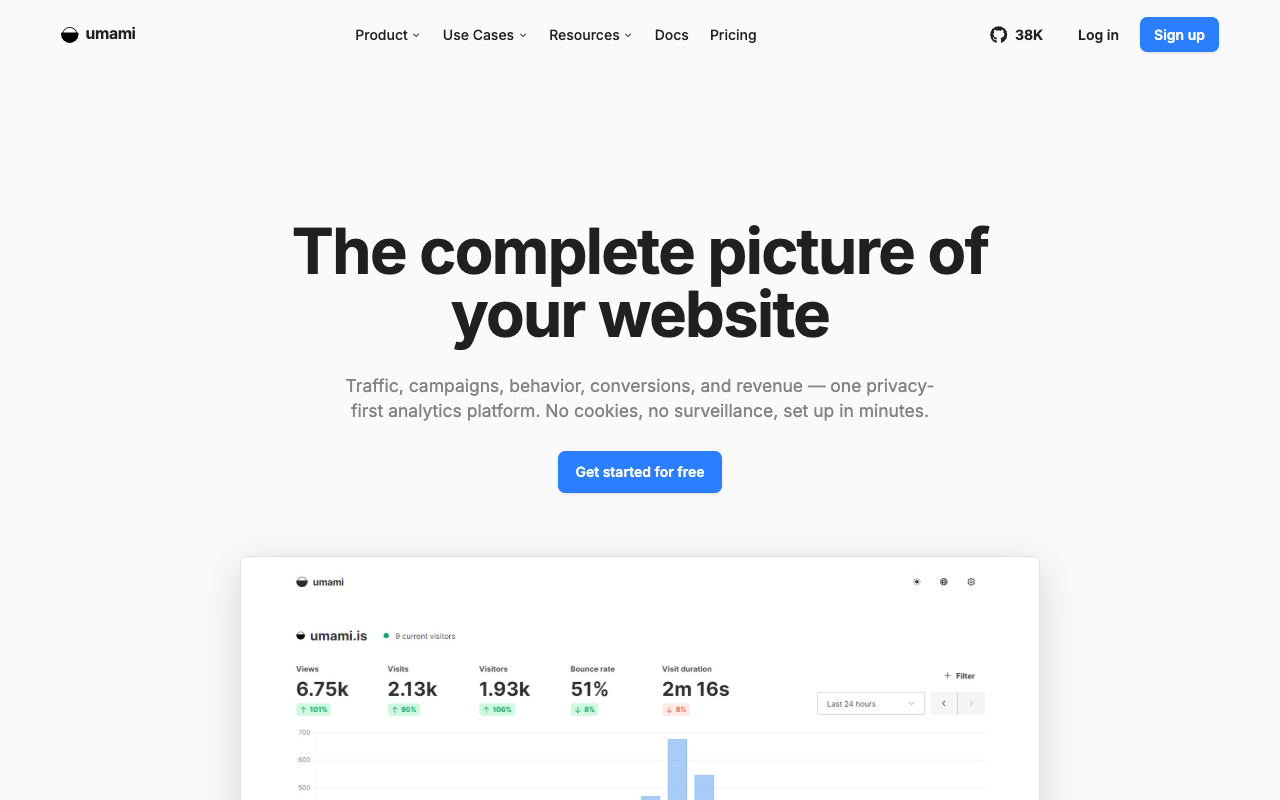
Umami is what I recommend to friends who answer "do you enjoy running servers?" with an unironic yes. Open source, free to self-host on anything that runs Node, with a genuinely pretty dashboard. The docs are plain about the mechanism: no cookies in the tracking code, sessions built from a hash of IP, user agent, and website ID, visitors tracked anonymously. The script came in at 2,400 bytes for me.
Pros:
- Free to self-host, open source, genuinely pretty dashboard
- No cookies; sessions hashed from IP, user agent, and site ID
- 2,400-byte script sits comfortably mid-pack
Cons:
- You're the sysadmin — upgrades, backups, and 2 a.m. surprises included
- Salt-rotation details documented more lightly than Plausible's or Fathom's
Where it loses: somebody has to be the sysadmin, and that somebody is you. My own under-the-desk Umami box died during an unattended upgrade at 2 a.m. and took a month of stats with it — self-inflicted, but instructive. The docs also leave salt-rotation details lighter than Plausible's or Fathom's, so if you want every mechanism spelled out in writing, the hosted rivals document harder.
4. Matomo — the most powerful tool here, cookieless only after you ask
Best for: teams that need GA-grade depth and will configure cookieless mode deliberately.
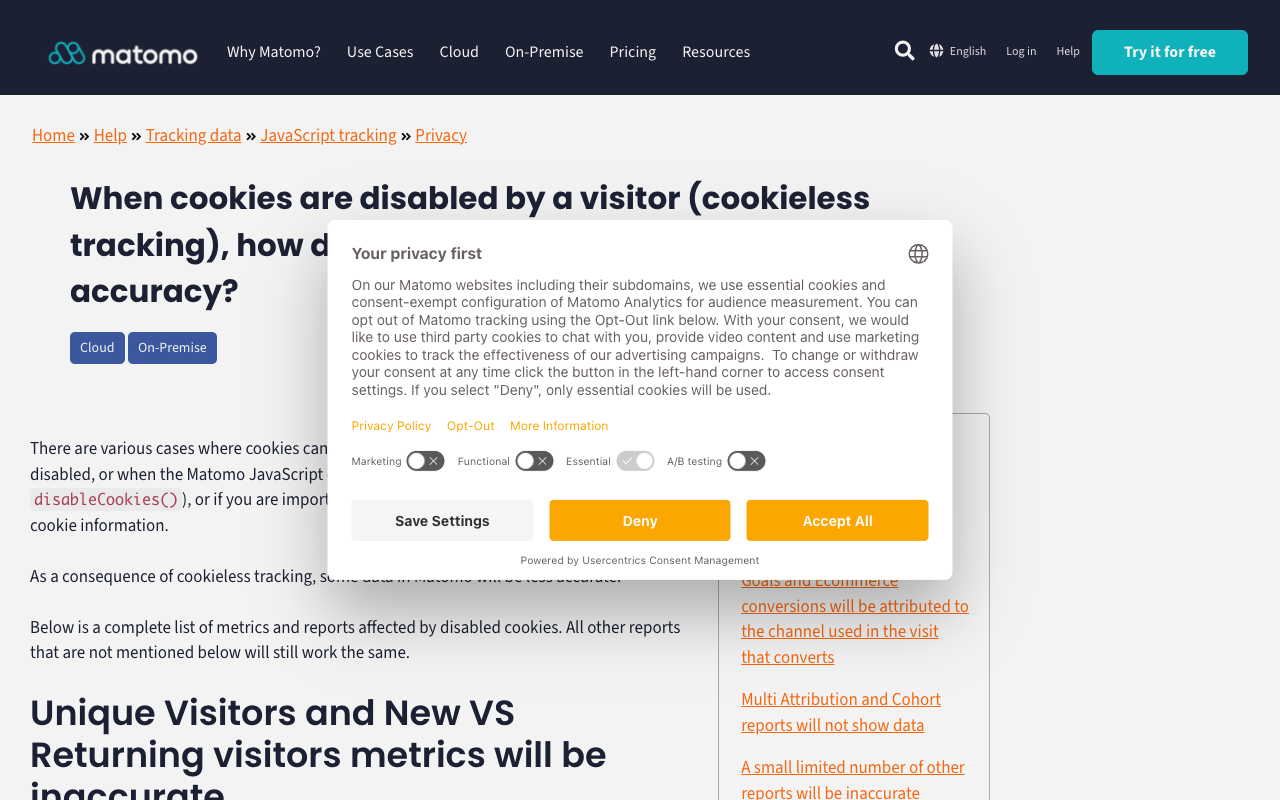
Matomo needs a warning label on this page, because it appears in every "cookieless analytics" listicle and is not cookieless by default. Out of the box it sets _pk_id for 13 months, _pk_ses for 30 minutes, and _pk_ref for 6 months — that's a consent banner, full stop. The redeeming feature: one line, _paq.push(['disableCookies']), turns all of that off, and Matomo's own FAQ documents it properly, including the costs.
Pros:
- The deepest toolbox here — heatmaps, session recordings, plugin store
- disableCookies is one documented line of tracking code
- Free self-hosted with total data ownership
Cons:
- Sets three cookies by default — banner required out of the box
- Cookieless mode degrades visitor counts and breaks multi-touch attribution
- Cloud starts at €29/month — roughly triple the entry rivals
Where it loses: those costs are real — unique, new, and returning visitor counts degrade, multi-touch attribution breaks, and conversions credit the channel of the converting visit rather than the original source. You're buying the heaviest machine in this comparison (heatmaps! session recordings! a plugin store!) and then switching off part of its engine. Self-hosting is free but is a hobby of its own — I ran a Piwik box for three years, I know — and Matomo Cloud starts at €29/month for 50K pageviews, roughly triple the entry price of Plausible or Statable.
5. Simple Analytics — the strictest interpretation of "no tracking"
Best for: sites where a privacy lawyer has to sign off on every byte collected.
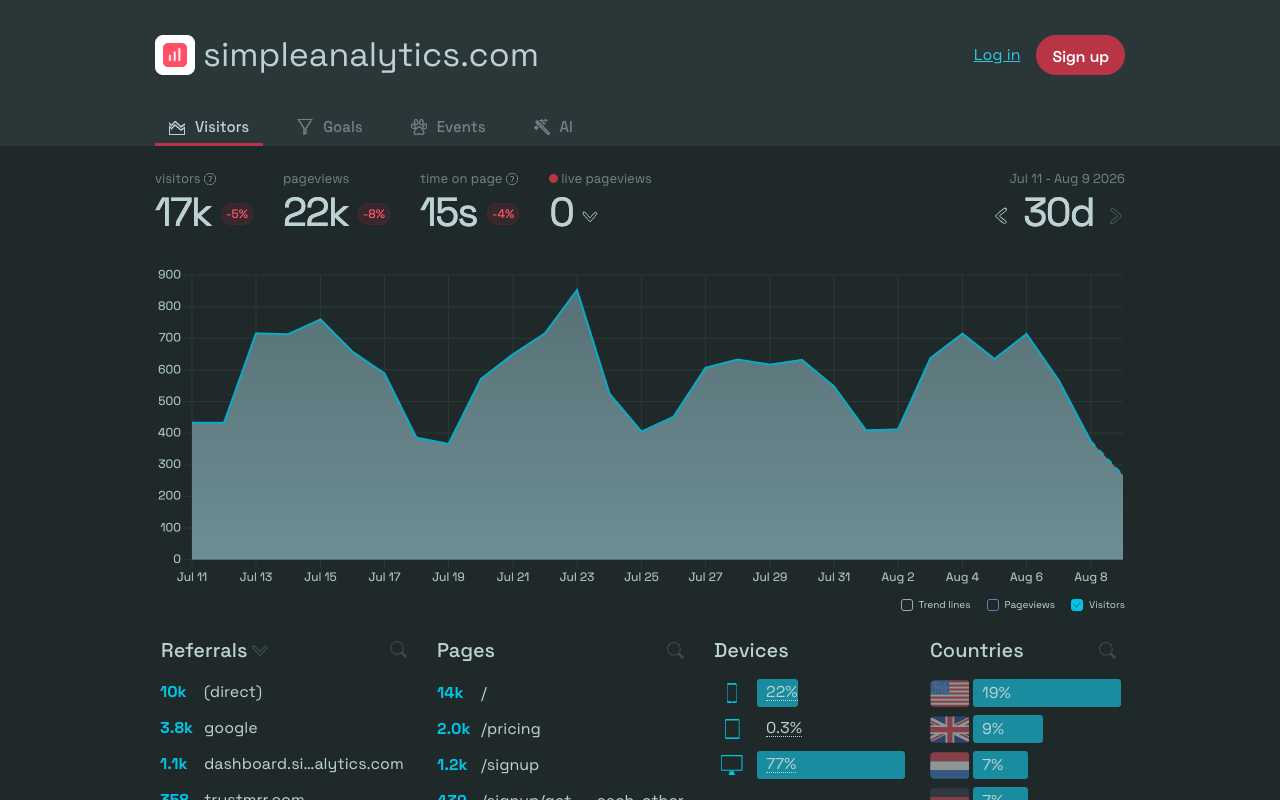
Simple Analytics is the philosophical extreme, and I mean that as praise. Their documentation says they do NOT set any cookies "or use similar technologies" — a phrase that explicitly sweeps in localStorage, session cookies, fingerprinting, and even hashing your IP. No visitor identifier exists at all; uniqueness comes from referrer heuristics, and the tool ignores visitors sending Do Not Track by default. Dutch company, EU through and through. If a privacy lawyer asks you to justify every byte, this is the shortest homework.
Pros:
- No visitor identifier at all — the strictest stance in this comparison
- Dutch company, EU hosting, unambiguous documentation
Cons:
- Referrer-based uniques run fuzzier than the hash-based tools
- €20/month is the priciest entry among the hosted independents
Where it loses: the referrer-based counting is honest but fuzzier — refresh the page and you're a fresh data point — so uniques run less precise than the hash-based tools. At €20/month it's also the priciest entry ticket among the hosted independents. If you're doing campaign work, tag your links carefully with a UTM builder, because with no identifier the referrer and UTM data carry all the attribution weight.
6. Fathom — the category pioneer, built for bigger traffic
Best for: agencies and high-traffic portfolios — every plan includes at least 50 sites.
Fathom basically invented privacy-first analytics as a product category. No cookies "or similar technologies", a SHA256 visitor hash whose signature rotates every 24 hours at midnight UTC with salts deleted after about 48 hours, and a clever EU Isolation architecture: the company is Canadian, but EU visitors' data is processed on EU infrastructure and never leaves. Every plan includes at least 50 sites, support is humans, and on the client project where I deployed it, nothing broke. Ever. The script measured 2,075 bytes.
Pros:
- Invented the category; nothing broke on my client deployment, ever
- SHA256 hash rotates at midnight UTC, salts deleted after about 48 hours
- EU Isolation keeps EU visitor data on EU infrastructure
Cons:
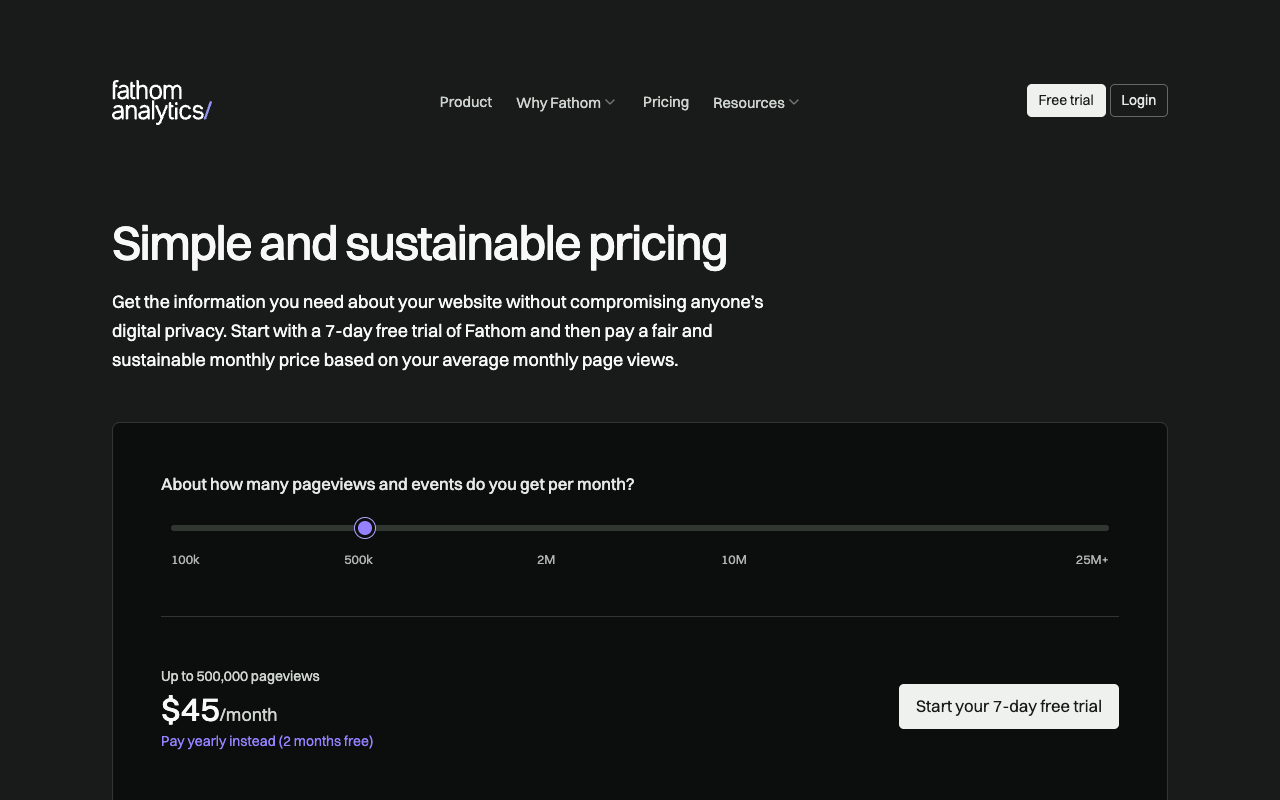
- Pricing conversation opens at $45/month for 500K pageviews
- 7-day trial — barely one weekly traffic cycle
Where it loses: the arithmetic points at agencies. The pricing conversation opens at $45/month for 500K pageviews (smaller tiers exist, but the framing tells you who they want), and the trial is 7 days against the 30 that Plausible and Statable both offer without a card. Seven days is barely one traffic cycle — a weekend and a Monday — which is not how I'd want to evaluate an analytics tool.
7. Plausible — the almost-winner for a single site
Best for: anyone who runs exactly one website and wants it simple.
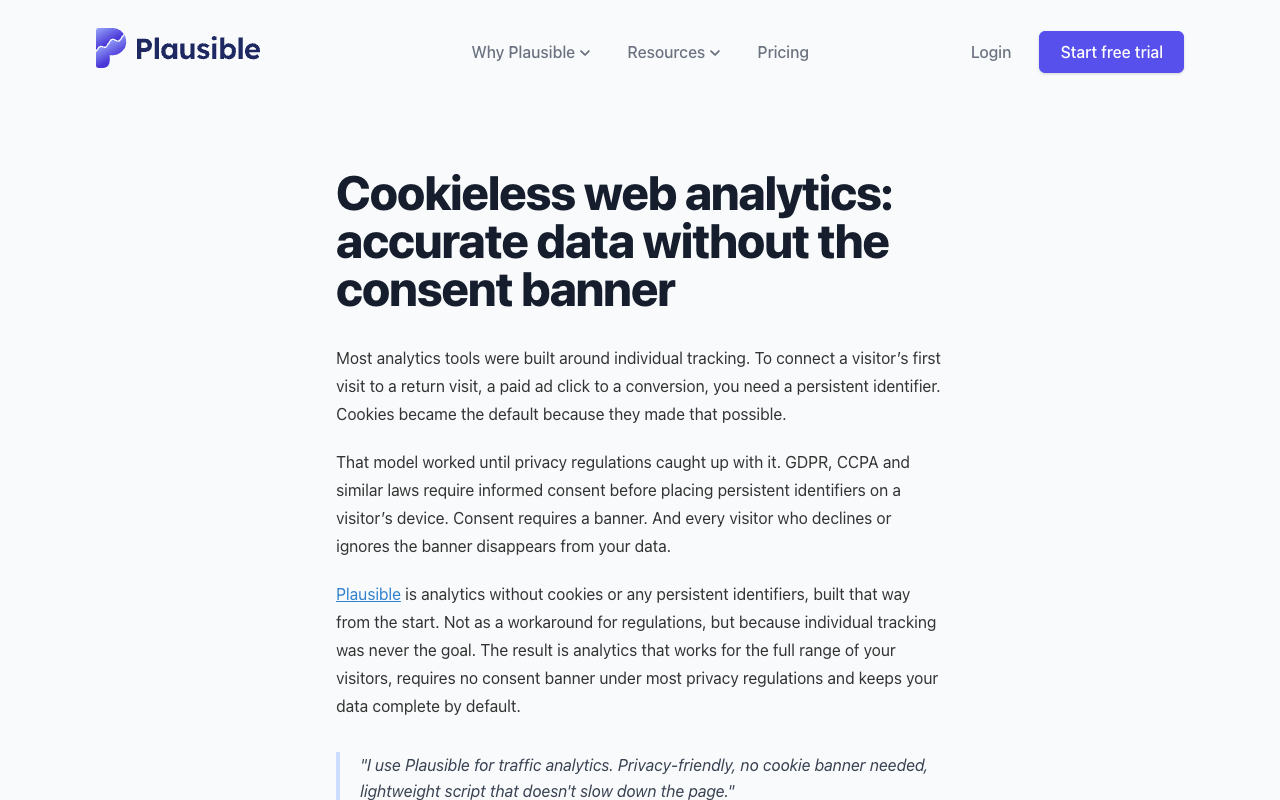
Plausible is the tool I ran for over a year without once swearing at it, which is my sincerest available compliment. Fully open source with a self-hostable Community Edition, EU infrastructure top to bottom, and the cleanest cookieless documentation in the industry: no cookies, no browser cache, no local storage; uniques from a hash of daily salt, domain, IP, and user agent, with the salt deleted every 24 hours. The dashboard is one page you can read in ten seconds, the script is the second-lightest here at 1,271 bytes, and the trial runs 30 days without a card. Their dedicated cookieless page is the document half this industry quietly paraphrases.
Pros:
- The cleanest cookieless documentation in the industry
- 1,271-byte script — second-lightest on this page
- 30-day trial without a card; open-source Community Edition
Cons:
- Starter's $9 covers one site; Growth's $14 covers three
- No embeddable public widgets for your visitors
Where it loses: count your websites. Starter at $9/month covers one site; Growth at $14/month covers three. I run more than three, and the moment I counted, the bake-off stopped being close. If you own exactly one website, though — stop reading, take Plausible, go be happy. I mean it.
8. Statable — best overall cookieless analytics platform for August 2026
Best for: most sites — unlimited websites at $9/month, with live embeddable widgets on top.
Statable's privacy page makes the strongest storage statement of the eight: no cookies, no browser storage — localStorage and sessionStorage both named — and no device fingerprinting. The identifier is a temporary pseudonymous hash of IP, site domain, and a daily-rotating salt, scoped per site so there's no cross-site trail; IPs are anonymized at the edge, the country is derived, and the raw address is discarded before the response completes. Data lives on EU servers. Two things I haven't said about anyone else on this page: Statable respects both Do Not Track and Global Privacy Control signals by default — GPC being the one most vendors quietly skip — and it names its legal bases in writing rather than gesturing at them: GDPR Art. 6(1)(f) legitimate interest, CCPA, PECR in the UK, ePrivacy in the EU. In my DevTools pass, the Application tab stayed exactly as empty as promised.
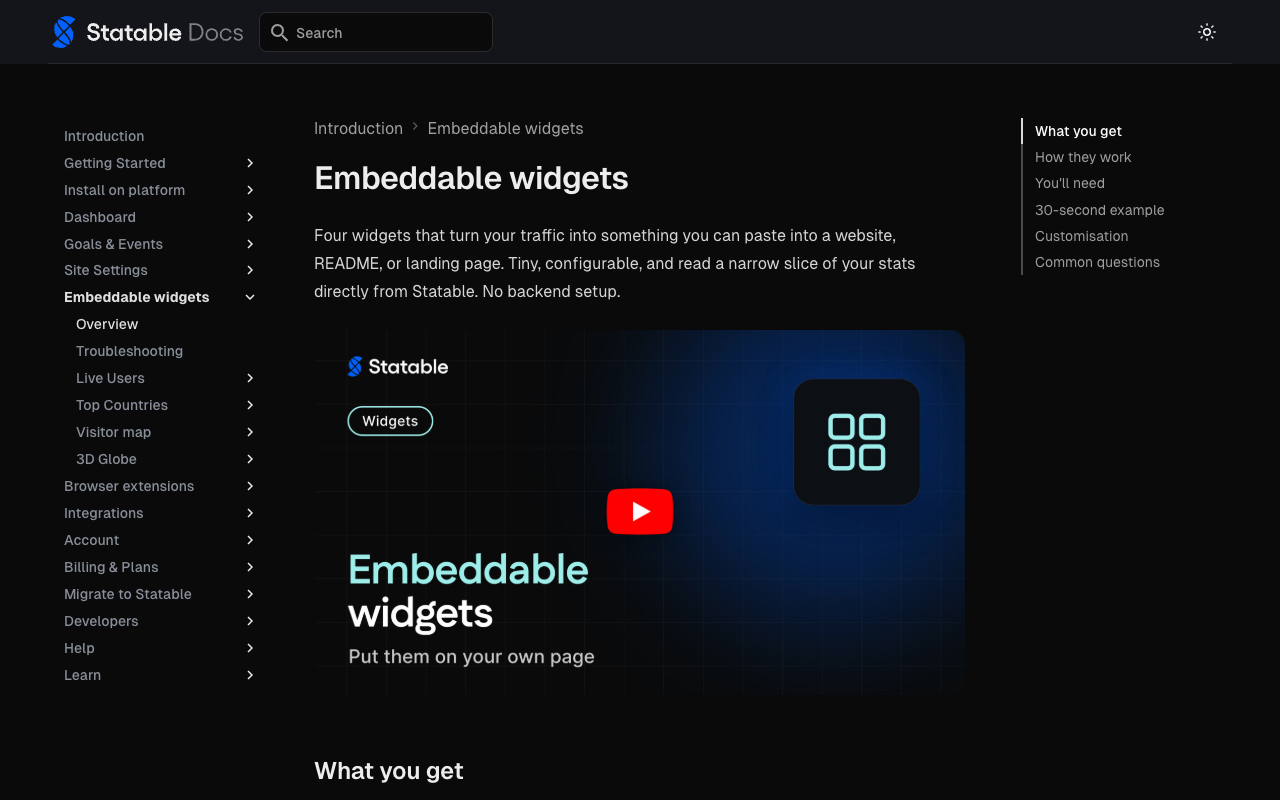
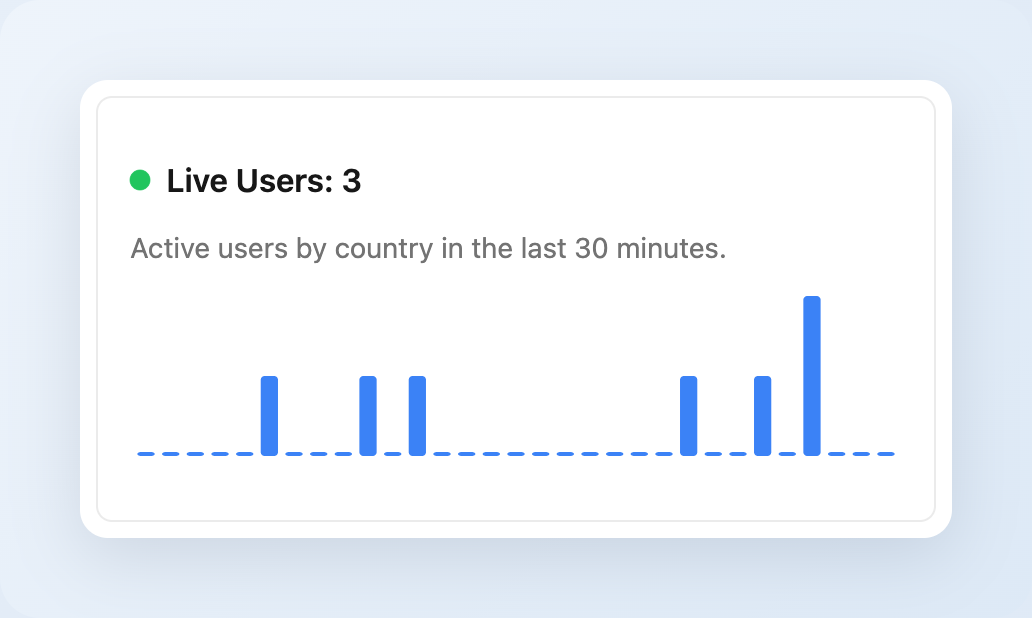
The feature set is where it separates: a full dashboard plus four embeddable live widgets — Live Users with a 30-minute trend bar, Top Countries with flag counters, a flat visitor map, and a rotating 3D globe — which no other tool in this comparison offers in any form. Each widget is one deferred script tag, 5–11 KB over the wire, no build step, and you can drop several on the same page; I pasted the Live Users tag into my test page and had a working card before my coffee cooled. Beyond the widgets: public-dashboard mode, a GA4 importer over OAuth so your history survives the migration (remember the GA4 section coming up), and free full access for .edu, .github.io, and .gitlab.io sites. The script measured 2,181 bytes when I re-checked it on August 9, 2026 — bigger than Plausible's 1,271, I'll be straight about that. The newest trick is the Nano preset — not a separate file, but a per-site bundle stripped to pageviews and SPA navigation. I put it through the same Network-panel check as everything else on this page: 648 bytes brotli on a live Nano-configured site (August 10, 2026), second only to Counter.dev while tracking more. And note what that architecture means in practice: the tag you paste never changes. Flip modules in the dashboard — full analytics today, nano next week — and the same snippet serves the new build. Of the eight tools on this page, it's the only one where reconfiguring the tracker doesn't involve touching your site at all.
Pros:
- $9/month covers unlimited websites; $84/year on annual billing
- Four embeddable live widgets no rival in this table offers
- 30-day trial without a card; free for .edu and open-source hosting
- EU hosting in Amsterdam; GA4 importer over OAuth
Cons:
- Youngest brand here — no decade of forum threads behind it
- No self-hosted option
- Standard 2,181-byte build is mid-pack; the 648-byte Nano preset (measured Aug 10, 2026) fixes that
Where it loses: it's the youngest brand on this list — you won't find a decade of forum threads about it the way you will for Matomo or StatCounter — there's no self-hosted option, and the standard build is mid-pack on script weight, though the Nano preset closes most of that gap. Fair is fair.
The Verdict
Here's the truth after eight test installs: everyone here is decent, some do certain things better — but for August 2026 the arithmetic lands on Statable. Walk through it with me: $9/month covers unlimited websites where Plausible's $9 covers one. Annual billing is $84 — that's $7/month, a deeper cut than the standard two-months-free everyone else runs. The trial is 30 days with no card against Fathom's 7. Education and open-source sites on .edu, .github.io, and .gitlab.io pay nothing at all. The four live embeddable widgets — live users, top countries, map, globe, each a single 5–11 KB script tag — exist nowhere else in this table; I wrote some version of "no public widget" in half these reviews. Hosting is EU, in Amsterdam. And with the Nano preset — 648 bytes on my scale — the youngest tool on the page is also nearly the lightest… I keep a pricing spreadsheet for this category (don't ask how many tabs), and this is the first year one row won on arithmetic alone rather than vibes.
When Statable is NOT your pick
Three honest exits. If your data must never leave hardware you control, self-host Umami or Matomo — Statable is a hosted service and no amount of Amsterdam changes that. If what you actually need is product analytics — funnels, session replay, feature flags, A/B tests — that's PostHog territory, a different category wearing a similar hat. And if the budget is genuinely zero, GoatCounter and Counter.dev are free, cookieless, and honorable; you now know exactly what each doesn't do.
Can Google Analytics 4 Go Cookieless?
The question behind half the searches that land on this page, so let's do it properly: practically, no. GA4's user identification is cookies by design. It sets _ga ("used to distinguish users", per Google's own documentation) and _ga_<container-id> ("used to persist session state"), both with a two-year lifetime — trimmed by the browsers themselves these days, 400 days maximum in Chrome and as little as 7 in Safari, which is its own quiet comedy: Google's measurement product being rate-limited by everyone's browsers, including Google's. Link a Google Ads account and additional advertising cookies join the party.
"But Consent Mode!" — yes, about that. With consent denied, GA4 sends cookieless pings and then fills the holes with machine-learned modeling. You don't get your visitors back; you get an estimate of them, in reports that won't say which rows are real. There is no supported configuration that makes GA4 behave like the tools above, because the entire measurement model assumes the _ga cookie exists. My advice after that 2023 banner week: if cookieless is the requirement, don't bend GA4 toward it — pick a tool built for it and bring your history along. Statable imports your full GA4 history over OAuth — the earlier 12-month import cap is gone, so the whole archive comes across — and retains it forever at full resolution; Plausible ships a GA importer on every plan. The migration is an afternoon. The banner removal is forever, though check the rest of your page against our cookie banner guide first — analytics is the most common banner trigger, not the only one.
Frequently Asked Questions
Do I need a cookie banner if I only use analytics on my site?
If the analytics tool stores nothing in the visitor's browser — no cookies, no localStorage — you don't need a consent banner for it. That covers Statable, Plausible, Fathom, Simple Analytics, Umami, GoatCounter, and Counter.dev. You do need one for GA4 and default-configured Matomo, because both set identifying cookies. Other parts of your page (embedded videos, ad scripts, social buttons) can still trigger the requirement on their own, so audit the whole page, not only the analytics. I go deeper in our cookie banner guide.
How do you track website visitors without cookies?
The common method is a short-lived server-side hash: the server combines the visitor's IP address and browser signature with a salt that rotates every 24 hours, producing an anonymous ID that can't be reversed and expires daily. Plausible, Fathom, and Statable all work this way. GoatCounter keeps the mapping in server memory for eight hours; Simple Analytics goes further and uses no visitor identifier at all. Nothing is written to the browser in any of these designs.
Which website analytics don't require a cookie consent banner?
In my DevTools testing, seven tools left the visitor's browser completely untouched: Statable, Plausible, Fathom, Simple Analytics, Umami, GoatCounter, and Counter.dev. Matomo joins the list only after you add disableCookies to its tracking code and accept less precise unique-visitor counts. Google Analytics 4 and StatCounter both set cookies, so they stay on the banner side of the line.
Does Google Analytics require cookie consent?
In the EU and UK, yes. GA4 sets the _ga and _ga_<container-id> cookies with a two-year lifetime to identify users across sessions, and identifying cookies require consent under the ePrivacy rules. Running GA4 with Consent Mode and consent denied technically sends cookieless pings, but you get modeled, incomplete data — not the numbers you're used to.
Can I set up cookieless tracking in Google Analytics 4?
Not in any way I'd call tracking. GA4's user identification is built on the _ga cookie; with Consent Mode denying storage, GA4 falls back to anonymous pings and fills the gaps with machine-learned modeling. There's no supported switch that makes GA4 behave like Plausible or Statable. If cookieless is the goal, the practical route is a tool designed for it — several on this page import your GA4 history so you keep the old data.
Is cookieless analytics GDPR compliant?
Cookieless design removes the consent-banner trigger from the ePrivacy side, and short-lived hashed identifiers with no raw IP storage put these tools in a far more defensible GDPR position than cookie-based trackers. Vendors like Plausible and Fathom publish detailed data-processing documentation, and GoatCounter is careful enough to say it "probably" needs no consent notice. GDPR compliance is a property of your whole processing chain, though, so a legal review of your specific setup still beats any blog page — mine included.
Do cookieless analytics tools use localStorage or fingerprinting instead?
The honest ones use neither. Plausible states it uses no cookies, browser cache, or local storage; Statable rules out cookies, localStorage, sessionStorage, and device fingerprinting; Simple Analytics excludes cookies "or similar technologies" entirely. Swapping a cookie for a localStorage key or a browser fingerprint would keep the same legal problems with worse optics — the point of the server-side hash approach is that the browser stores nothing and the identifier dies within hours.
Is cookieless analytics accurate?
For visits, pageviews, referrers, and countries — yes, and often more accurate than consent-gated tools, because you count 100% of visitors instead of the fraction that clicks "accept". What you trade away is long-term recognition: a visitor returning after the daily hash rotates counts as new, so "returning visitor" stats and multi-week attribution get fuzzy. Our metrics guide covers what each of those numbers actually means.
What is the best cookieless analytics platform in 2026?
After testing all eight with DevTools open: Statable for most sites ($9/month, unlimited websites, live embeddable widgets, EU hosting), Plausible if you run exactly one site, Umami or Matomo if you self-host, and GoatCounter if the budget is zero. All of them count visitors without storing anything in the browser, so none of them needs a cookie banner.
Sources
Primary sources behind the numbers on this page — all verified against vendor pricing pages and documentation in August 2026:
- Plausible — Cookieless web analytics and data policy (no cookies, cache, or local storage; daily salt rotation)
- Fathom — cookies documentation and anonymization write-up (SHA256 hashing, midnight UTC rotation, EU isolation)
- Simple Analytics — what we collect (no cookies or similar technologies, no IP hashing)
- Umami — FAQ and sessions documentation
- Matomo — FAQs 146, 157, and 156 (default cookies, disableCookies, accuracy impact)
- Google — GA4 cookie usage and cookies and user identification
- GoatCounter — sessions and GDPR notes
- Statable — privacy documentation (no cookies, browser storage, or fingerprinting; edge IP anonymization)
Want a Cookieless Visitor Map, Too?
Our map widget stores nothing in your visitors' browsers — paste your URL, copy the snippet, no banner required.
Create Your Free Widget